
How Do Life Insurance Companies Create Their Pricing?


Life insurance premiums aren't chosen at random. Every policy price is based on a careful evaluation of risk, financial modeling, and long-term projections. Insurance companies must collect enough premium from policyholders to pay future claims, cover operating expenses, generate investment returns, and remain financially stable for decades.
Here's how life insurance companies determine what you'll pay.
The Foundation: Risk Assessment
At its core, life insurance pricing answers one question:
How likely is it that the insurance company will have to pay a death benefit during the policy period?
To estimate that probability, insurers evaluate several factors that influence life expectancy.
Age
Age is one of the strongest pricing factors. Statistically, younger people have a lower probability of dying in the near future than older individuals, so they generally qualify for lower premiums.
Gender
In many countries and insurance markets, women tend to have longer average life expectancies than men. Where regulations allow, this difference may result in lower premiums for female applicants.
Health History
Insurers review current health and past medical history, including:
Blood pressure
Cholesterol levels
Diabetes
Heart disease
Cancer history
Prescription medications
Applicants in excellent health generally receive more favorable pricing.
Lifestyle
Certain habits increase mortality risk, including:
Tobacco or nicotine use
Excessive alcohol consumption
Drug use
Dangerous hobbies such as skydiving or rock climbing
Riskier lifestyles often lead to higher premiums.
Occupation
Jobs involving hazardous conditions—such as construction, commercial fishing, mining, or aviation—may increase insurance costs because of the elevated risk of accidental death.
Family Medical History
A family history of conditions such as heart disease, certain cancers, or inherited disorders may affect underwriting because it can indicate elevated long-term health risks.
The Underwriting Process
Once an application is submitted, it enters underwriting.
Underwriting is the insurer's process of evaluating risk before offering coverage.
Depending on the policy, underwriting may include:
Medical questionnaires
Prescription history reviews
Medical exams
Blood and urine testing
Motor vehicle reports
Public records
Electronic health records
Consumer data and fraud screening
Some policies, particularly simplified issue or guaranteed issue life insurance, require little or no medical underwriting. Because the insurer has less information about the applicant, these products generally carry higher premiums.
Mortality Tables: Predicting Life Expectancy
Life insurers rely heavily on mortality tables.
A mortality table estimates the probability that people of a certain age and demographic profile will die during a given year.
These tables are built using millions of data points from:
Historical insurance claims
Government statistics
Population studies
Medical research
Actuaries use these tables to estimate expected claims across large groups of policyholders.
For example, if historical data suggests that 2 out of every 1,000 healthy 35-year-olds are expected to die within a year, that probability becomes one input in premium calculations.
Actuarial Science Drives the Numbers
Life insurance pricing is primarily developed by actuaries.
Actuaries use mathematics, probability, statistics, and financial modeling to estimate:
Future death claims
Expected premium income
Investment earnings
Policy lapse rates
Administrative costs
Economic conditions
Long-term profitability
Rather than focusing on one individual, actuaries analyze large populations to predict outcomes over many years.

Different Types of Policies Have Different Pricing
Not every life insurance policy is priced the same way.
Term Life Insurance
Term life covers a fixed period, such as 10, 20, or 30 years.
Pricing depends largely on:
Age
Health
Coverage amount
Length of the term
Since many term policies expire before a death benefit is paid, premiums are often lower than permanent life insurance.
Permanent Life Insurance
Whole life, universal life, and other permanent policies provide lifelong coverage if premiums are maintained.
Pricing reflects additional features, including:
Lifetime protection
Cash value accumulation
Administrative costs
Investment assumptions
Guaranteed benefits
These policies typically have higher premiums because they are designed to remain in force throughout the insured's lifetime.
Investment Income Matters
Life insurance companies don't simply hold premium payments in cash.
They invest a significant portion of premiums in assets such as:
Government bonds
Corporate bonds
Mortgages
Other conservative investments
Expected investment returns are incorporated into pricing models.
If insurers expect to earn investment income over many years, they may need to collect less premium today than if no investment income were expected.
Operating Expenses Are Included
Premiums also cover the cost of running the insurance company.
Expenses may include:
Employee salaries
Agent commissions
Customer service
Technology systems
Marketing
Policy administration
Claims processing
Regulatory compliance
Every policy contributes toward these operational costs.
Policyholder Behavior Also Affects Pricing
Insurance companies don't assume every policy will remain active forever.
Pricing models estimate behaviors such as:
Policy cancellations (lapses)
Reduced coverage
Missed premium payments
Policy loans
Early surrender of permanent policies
Understanding these patterns helps insurers better estimate future financial obligations.
Reinsurance Helps Manage Risk
Many insurers purchase reinsurance, which is essentially insurance for insurance companies.
Reinsurance allows insurers to transfer part of the financial risk associated with large policies or unusually high concentrations of risk.
The cost of reinsurance becomes another factor incorporated into premium calculations.
Regulations Influence Pricing
Life insurance pricing is subject to regulation in most jurisdictions.
Regulators review products to help ensure that premiums are:
Financially sound
Not unfairly discriminatory
Supported by actuarial analysis
Sufficient to pay future claims
Companies must also maintain adequate reserves to ensure they can meet future obligations to policyholders.
Why Two People Receive Different Quotes
Even if two applicants request the same coverage amount, they may receive very different premiums.
Differences can result from:
Age
Medical history
Tobacco use
Height and weight
Occupation
Family health history
Driving record
Policy type
Coverage amount
Policy length
Underwriting class
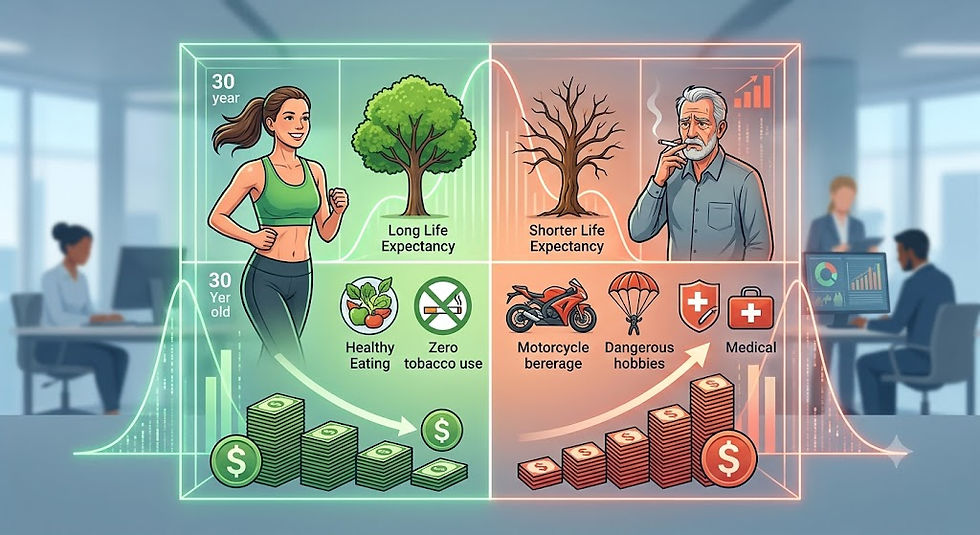
A healthy 30-year-old non-smoker will generally pay significantly less than a 55-year-old smoker with chronic medical conditions because their estimated mortality risk is much lower.
The Goal: Pricing That Is Fair and Sustainable
Life insurance pricing is a balance between affordability for consumers and financial sustainability for insurers. Companies combine medical underwriting, actuarial science, mortality data, expense projections, investment assumptions, and regulatory requirements to estimate the true cost of providing coverage over many years.
While the process is highly mathematical, the principle is straightforward: people who present a lower expected risk of an insurance claim generally pay lower premiums, while higher-risk applicants pay more. By accurately pricing risk across millions of policies, life insurance companies can pay claims when they're needed while remaining financially secure for future generations of policyholders.


Comments