
Errors & Omissions Insurance 201: What Fee-Only Financial Planners Should Know Before a Claim Happens


For fee-only financial planners, errors and omissions (E&O) insurance can be easy to treat as a box to check.
You buy a policy, send the certificate where it needs to go, renew it each year, and hope you never need it.
But understanding how your coverage actually works becomes much more important when something goes wrong—or when a client simply believes something went wrong.
That distinction matters. An E&O claim does not necessarily mean you made a mistake. A client can allege negligence even when you believe your advice was reasonable, your process was sound, and your documentation was thorough. Defending that allegation can still take time and money.
This is where E&O gets more interesting than “Do I have insurance?”
Consider this your E&O Insurance 201: a practical look at how coverage can come into play for fee-only financial planners and what common claims scenarios can teach you about managing risk.
First, What Is E&O Insurance Actually Protecting?
At a high level, E&O insurance is professional liability coverage. It is designed to respond to certain claims alleging that your professional services caused a client financial harm.
For a financial planner, allegations might involve investment advice, financial planning recommendations, retirement projections, insurance-related advice, tax-related planning, or another service included within the scope of the policy.
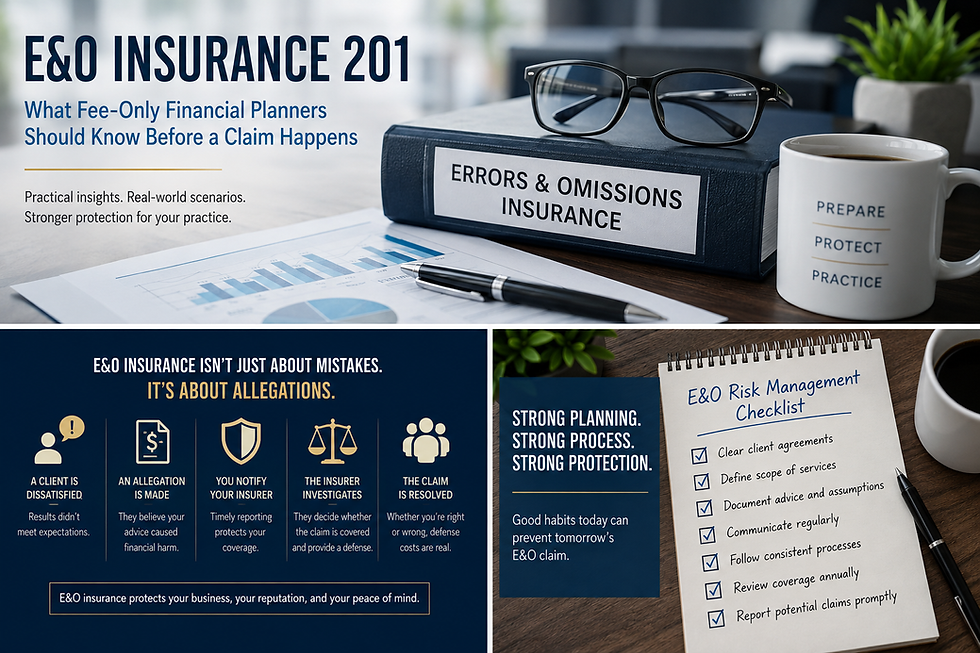
The important word is allegations.
You do not necessarily need to have committed an error for a situation to become expensive. A dissatisfied client may allege that your advice caused a loss, and you may need an attorney and other resources to defend your firm.
Of course, exactly what a policy covers depends on its wording, definitions, exclusions, endorsements, limits, deductibles or retentions, and the facts surrounding the claim.
That is why planners should understand the mechanics of their own policy rather than assuming all E&O insurance works the same way.
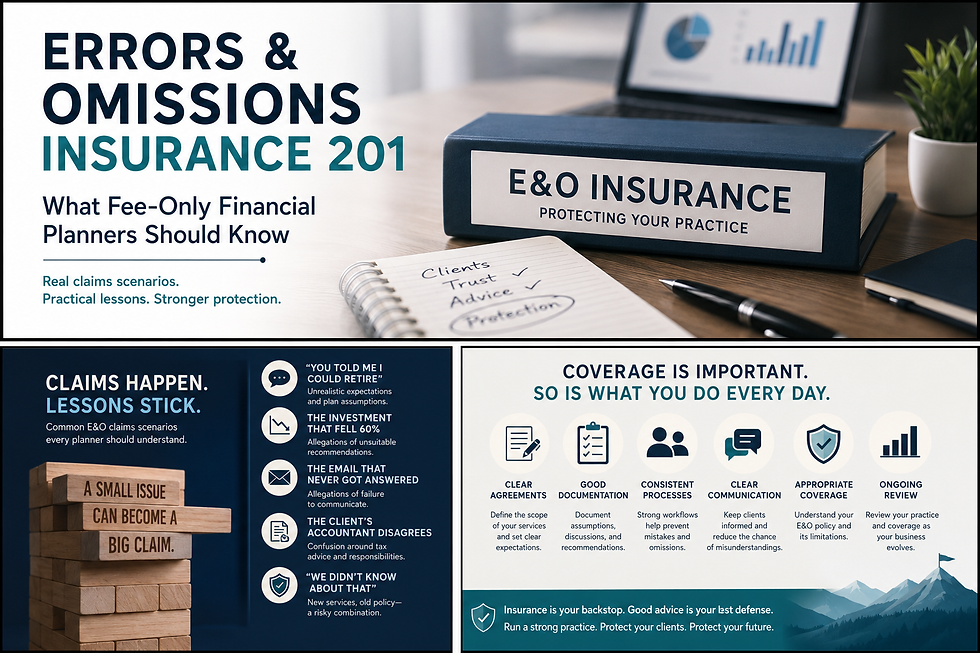
Scenario #1: “You Told Me I Could Retire”
Imagine a client comes to you at age 61. You build a financial plan, model several scenarios, discuss assumptions, and ultimately conclude that retirement appears feasible.
Three years later, the client's portfolio has performed poorly, expenses have been higher than projected, and the client is worried about running out of money.
Then comes the allegation:
“My advisor told me I could retire. Now I can't afford my lifestyle.”
Whether that characterization is fair is almost beside the point from an insurance perspective. The client has connected professional advice with alleged financial harm.
This is the type of situation where documentation can become extremely important.
Did the plan clearly state its assumptions? Did you document conversations about uncertainty and risk? Did the client understand that projections were not guarantees? Did you recommend periodic updates? Did circumstances change after the original recommendation?
The lesson
Financial planning involves assumptions about the future. Clients, however, may remember a nuanced discussion as a definitive recommendation.
Document not just what you recommended, but also the assumptions, risks, alternatives, and limitations surrounding that recommendation.
Good documentation cannot prevent every claim, but it can make a significant difference when everyone's memory of a conversation is suddenly different.
Scenario #2: The Investment That Fell 60%
A client wants to make a concentrated investment. You discuss the risks but ultimately advise the client on the position.
Then the investment collapses.
The client alleges that you should have known the investment was inappropriate given their age, risk tolerance, liquidity needs, or overall financial situation.
This scenario raises several E&O questions.
Does the policy's definition of professional services encompass the activity? Are there exclusions involving certain securities, investments, or outside business activities? Is the advisor's conduct within the scope of what was disclosed to the insurer?
Even if the underlying allegation ultimately proves unsuccessful, defending it may still be costly.
The lesson
Don't assume “investment advice” automatically means every investment-related activity is covered.
Review how your policy defines professional services and pay attention to exclusions. If your practice begins offering advice in areas that weren't part of the business when you originally applied for coverage, that may be worth discussing with your insurance professional.
Your practice can evolve faster than your insurance policy does.
Scenario #3: The Email That Never Got Answered
A longtime client emails on a Friday afternoon asking whether they should sell a position.
The message gets buried.
By the time the advisor sees it, the investment has fallen significantly. The client claims the advisor's failure to respond caused the loss.
Is the advisor responsible? That depends on the facts.
But the situation illustrates an important point: E&O exposures aren't limited to giving the wrong advice.
Sometimes the allegation is that you failed to do something.
Failed to communicate. Failed to implement. Failed to follow up. Failed to execute an agreed-upon action. Failed to provide advice that the client expected you to provide.
Hence the “omissions” in errors and omissions.
The lesson
Operational processes are part of risk management.
Clear service standards, defined responsibilities, CRM workflows, documented follow-ups, and procedures for handling client requests can reduce the likelihood that something simply falls through the cracks.
Scenario #4: The Client's Accountant Disagrees
Suppose you provide tax planning as part of a comprehensive financial planning engagement.
You discuss a strategy with a client. The client acts on it. Months later, their CPA takes a different view, and the client receives an unexpected tax bill.
Now the client alleges your advice caused the problem.
This is where the exact scope of your professional services matters.
“Tax planning” can mean very different things across advisory firms. One planner might identify planning opportunities and coordinate with a CPA. Another might provide detailed tax recommendations. Another may prepare returns.
Your E&O policy may care about those distinctions.
The lesson
Make sure the services you actually provide line up with both your client agreements and the professional services contemplated by your E&O coverage.
It is also worth being precise with clients about where financial planning ends and legal, tax, accounting, or other professional advice begins.
Scenario #5: “We Didn't Know About That”
Suppose a firm adds a new service.
Maybe it begins advising on private investments, offers expanded tax planning, starts serving retirement plans, or introduces another specialized service.
A year later, a claim arises from that work.
Only then does the firm discover that its insurer was working from an outdated description of the business—or that the policy contains language relevant to the new activity.
This can create a difficult conversation at exactly the wrong time.
The lesson
E&O insurance should not be a once-a-year administrative exercise.
When your firm's services materially change, consider whether your insurance needs to change with them.
New services, new types of clients, acquisitions, new advisors, outside business activities, and changes in assets or revenue can all be reasons to revisit coverage.
Claims-Made Coverage Changes the Conversation
One of the most important concepts for planners to understand is that many professional liability policies are written on a claims-made basis.
That means the timing of a claim—and potentially when the underlying circumstances occurred or became known—can matter significantly.
This makes concepts such as the policy period, retroactive or prior-acts date, continuity of coverage, and timely reporting especially important.
For example, changing insurers solely because another policy is cheaper can create unintended consequences if the new coverage does not preserve appropriate prior-acts protection.
Similarly, waiting until a client has filed a lawsuit before notifying an insurer may be a mistake. Depending on the policy, circumstances that could reasonably develop into a claim may have their own reporting requirements.
The lesson
Know what your policy requires you to report and when.
If a client threatens legal action, demands compensation, sends an unusually serious complaint, or otherwise signals a potential claim, review the policy's reporting provisions and contact the appropriate insurance professional rather than assuming it can wait until the situation becomes formal.
Defense Costs Deserve More Attention
Planners often focus on one number when evaluating E&O insurance: the liability limit.
For example, a policy might provide $1 million of coverage.
But that number doesn't tell the entire story.
One important question is how defense expenses interact with that limit.
If defense costs erode the policy limit, money spent defending a claim can reduce the amount remaining to fund a settlement or judgment. Other policy structures may treat defense expenses differently.
Neither detail should be discovered for the first time after a claim arrives.
Planners should also understand whether and how deductibles or self-insured retentions apply to defense expenses.
Your Policy Has Boundaries
No E&O policy covers everything that could go wrong in an advisory business.
Policies commonly contain exclusions and limitations, although the specifics vary substantially.
Depending on the policy, relevant areas might include intentional or fraudulent acts, certain outside business activities, specific investment products, services not included within the definition of professional services, prior-known circumstances, cyber events, employment matters, or other exposures.
This is another reason to avoid evaluating E&O insurance based solely on premium and limits.
Two policies that both say “$1 million E&O” on the declarations page can provide meaningfully different protection.
What Should a Fee-Only Planner Review?
You do not need to become an insurance lawyer to ask better questions about your coverage.
At renewal—or whenever your practice changes—look beyond the premium. Ask about:
The definition of covered professional services
Policy limits and whether there are aggregate limits
Deductibles or self-insured retentions
How defense costs affect your limits
Retroactive or prior-acts coverage
Requirements for reporting claims and potential claims
Major exclusions relevant to your practice
Coverage for newly added services
Coverage for current and former employees or advisors
How coverage responds if you sell, merge, retire, or close the firm
Whether separate cyber, employment practices, crime, or other coverage may be needed for exposures outside E&O
Most importantly, compare the policy to what your firm actually does.
Your website, Form ADV, client agreement, internal procedures, and insurance application should tell a reasonably consistent story about your business.
The Bigger Lesson: E&O Is Only One Part of Risk Management
Insurance is the financial backstop.
The first line of defense is still how you run the firm.
Clear engagement agreements help establish the scope of the relationship. Good documentation helps reconstruct conversations months or years later. Consistent workflows reduce omissions. Thoughtful compliance procedures catch problems earlier. Clear communication helps keep misunderstandings from becoming disputes.
And when something does go wrong, knowing how your E&O coverage works can keep an unpleasant situation from becoming even more complicated.
For fee-only planners, the goal shouldn't simply be to have E&O insurance.
The goal should be to understand what you bought, know where its boundaries are, and operate the firm in a way that gives the coverage the best chance to do its job when you need it.
Because the worst time to learn how your E&O policy works is after the claim has already arrived.
This article is for general educational purposes only and does not constitute legal, insurance, compliance, tax, or other professional advice. Insurance coverage depends on the specific terms, conditions, exclusions, endorsements, and facts applicable to each policy and claim. Consult qualified professionals regarding your firm's specific circumstances.


Comments